
Can Wooden Homes Survive the Indian Climate? A Guide to Durability and Weather Resistance
Home/ Can Wooden Homes Survive the Indian Climate? A Guide to Durability and Weather Resistance
Home/ Can Wooden Homes Survive the Indian Climate? A Guide to Durability and Weather Resistance
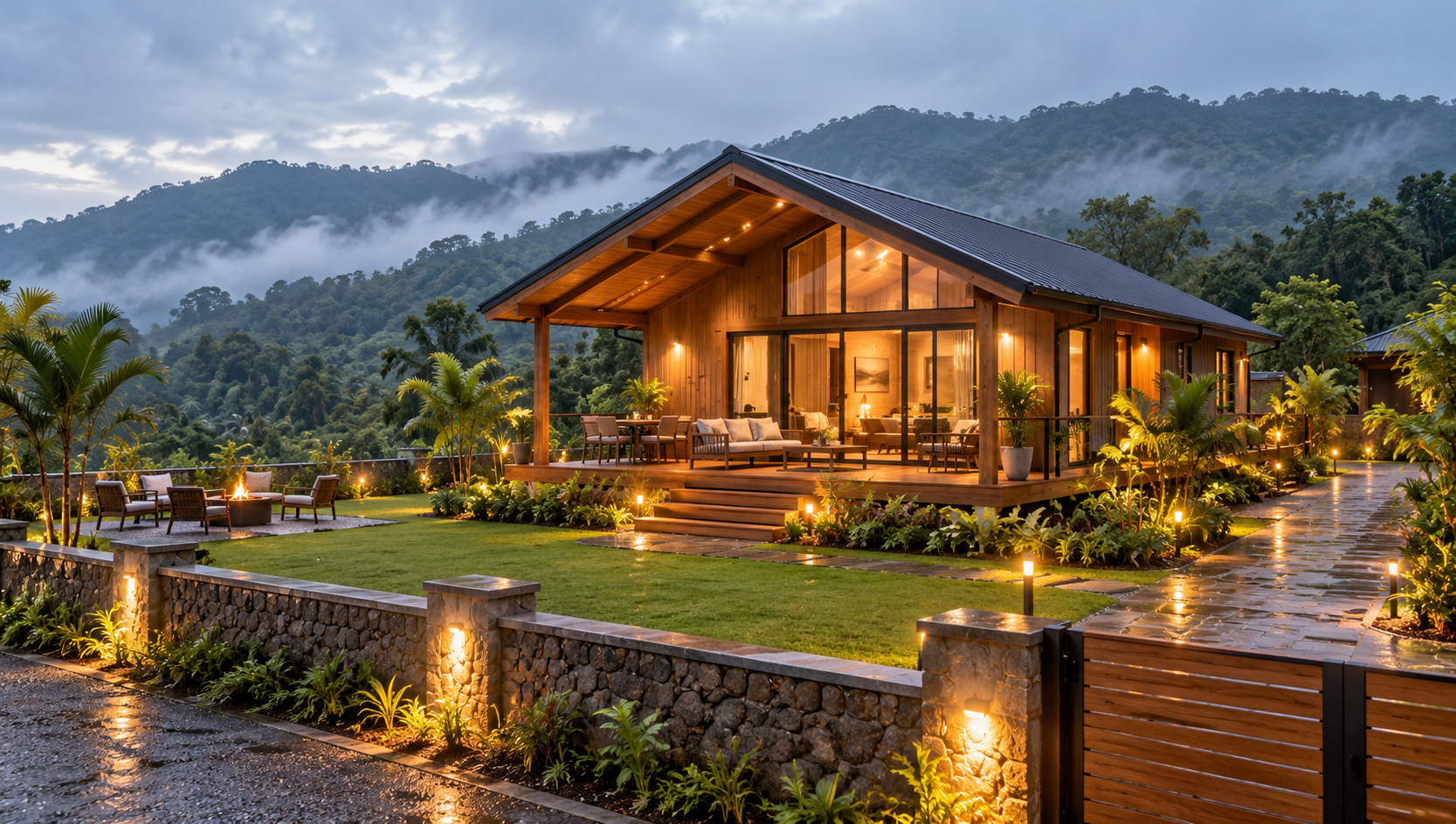
Ask ten people about wooden homes in India, and you will probably hear the same three worries: the monsoon will rot it, termites will eat it, and it will warp the first summer. These are fair concerns. They come from watching ordinary timber fail in Indian conditions, usually because it was never prepared for them.
The better question is what happens to the wood before it becomes a wall. The majority of the differences in the durability of wooden houses originate from this process, which is why this guide begins here.
Freshly cut timber is full of water. Raw logs can hold 80 to 90% moisture by weight, and wood keeps exchanging moisture with the air around it. In a humid coastal town, it swells. In a dry heatwave, it shrinks. Over a few seasons, that cycle opens gaps, cracks boards and twists frames.
Moisture also invites trouble. Damp wood is easier for fungi and wood-boring insects to colonise, which is why termite damage and rot so often arrive together. A home that has to survive 30 monsoons needs wood that the factory has stabilised and protected, not just painted on site.
Techle Indo Innovation builds its Woodle wooden homes from Indonesian hardwoods that go through a five-stage fortification process at our manufacturing unit in Jepara. Each stage targets one of the problems above.
It begins with sourcing. The timber comes directly from SVLK-certified legal entities in Jepara, without suppliers or middlemen in between. That keeps every log traceable, and it means the wood entering the process is known stock.
The logs are then sawn to exact dimensions, which is important later when the panels have to fit together to the millimetre. The third stage is vacuum pressure and chemical treatment. A vacuum chamber pulls moisture out of the wood, and protective agents are driven into the fibres to a confirmed depth of 4mm. This treatment removes hidden insect larvae and leaves a barrier that stays in the wood rather than sitting on its surface. It is the reason a treated board behaves differently from a coated one, and it is the foundation of any termite-resistant wooden home.
Stage four is industrial kiln drying, which runs for 10 to 15 days. The wood comes out at a controlled moisture content of 8 to 12%. Once it is stabilised at that level, it has far less reason to swell, shrink or twist when the weather changes. Stage five is final component processing, where the stabilised timber is crafted into panels, flooring and frames and finished to architectural specifications. A PU coating is applied at the end to help the surface shed water.
Moisture is the main test for any wooden structure in India, whether the house is on the Konkan coast or in the Western Ghats. Kiln-dried wood at 8 to 12% moisture, finished with a PU coat, is built to cope with sustained humidity and heavy rain. Wood in this state does not absorb water as fresh timber does.
It is worth being straight about the limits. No wood should sit submerged, and effective drainage around the base of any building still matters. A well-detailed foundation and a roof designed for heavy rain are part of the system.
Heat is also a key factor. Solid wood has low thermal conductivity, so it does not soak up and radiate heat the way concrete tends to. Woodle wall panels also carry an EPS foam core, covered with an aluminium sheet, between layers of solid wood. This insulation helps keep interiors cooler through a hot plains summer and warmer in the hills, which also eases the load on fans and air conditioning.
For many buyers, termites are the biggest worry. Surface treatment cannot fully address it, because insects find the untreated core. The vacuum pressure stage works from the inside, pushing protection into the fibres and removing any larvae that are already present in the log. The result is timber that is resistant to termites and wood borers by design, which is the real meaning of a termite-resistant wooden home. The hardwoods themselves also help. Teak and Merbau contain natural oils that resist fungal decay.
Two other questions arise often. On fire, dense hardwood behaves differently from the way people expect. When exposed to flame, the outer surface chars, forming an insulating layer that slows heat transfer to the core. Woodle homes are built on this behaviour, with wood charring that lasts for up to 3 hours, giving occupants time to respond.
On earthquakes, wood is naturally flexible and light. A light frame panel system can absorb and flex with seismic vibration instead of resisting it rigidly, which is why timber structures are well suited to earthquake-prone regions.
The way builders construct a wooden home matters as much as the material. Prefab wooden houses are manufactured in a controlled factory, so panels are cut, dried, and finished away from the rain, dust, and humidity that affect site-built timber. The components are shipped to the site and assembled using a snap-together system. Woodle homes can typically be assembled in about two weeks once the components arrive, depending on size.
The lighter structure also helps in places where heavy construction is difficult. Hillsides, coastal plots, farmhouses, and city rooftops all benefit from simpler foundations and less earth-moving. As with any permanent structure, local municipal or panchayat approvals are required, and the process is generally straightforward because the homes are designed to meet safety and fire standards.
Treated timber needs far less upkeep than people expect, but it is not maintenance-free. A protective exterior coat every few years keeps the surface looking fresh and the finish performing. Beyond that, keep drainage clear, avoid harsh chemical cleaners, and check fittings from time to time.
Yes, a wooden home can handle Indian conditions, provided the wood has been prepared for them. The outcome depends on certified sourcing, deep vacuum treatment, kiln drying to a stable 8 to 12%, and factory-controlled prefab construction. Skip those, and timber struggles. Follow them, and it can perform well in monsoon, heat, and humidity.
The easiest way to judge the quality is to look at how the wood is made. At our Experience Centre in Devanahalli, Bengaluru, you can walk through finished wood units and see the timber and judge the build's solidness before making your decision.