
Wood Treatment Process: Inside Techle Indo Innovation's 5-Step Jepara Factory Method?
Home/ Wood Treatment Process: Inside Techle Indo Innovation's 5-Step Jepara Factory Method?
Home/ Wood Treatment Process: Inside Techle Indo Innovation's 5-Step Jepara Factory Method?
Most buyers who walk into our Experience Centre in Devanahalli ask the same questions. What does the home look like from the outside? How long does installation take? Can I customise the interior? All reasonable.
But in nearly a decade of building prefab wooden homes in India, we've noticed that almost nobody asks the one question that actually determines whether a prefab home lasts 15 years or 50: what happened to the wood before it got here?
This piece answers that. In full, with actual numbers.
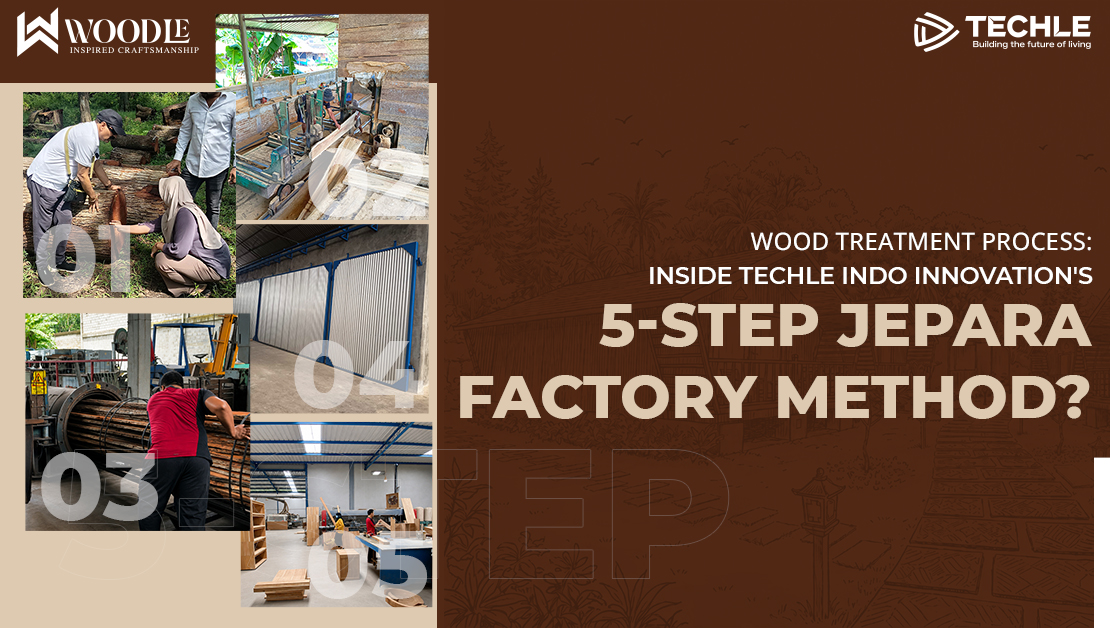
Here's exactly what Woodle timber goes through at our Jepara factory before it becomes part of a prefab wooden home in Bengaluru or anywhere else in India.
Brands, even reputable ones, tend to speak in generalities. "We use premium wood." "Our wood is treated." "We source legally." Most of them might not give you exact data/proof. And honestly, the vagueness is usually intentional.
Here's why it matters. India's climate is hostile to wood in ways that temperate-country timber standards don't anticipate. The Deccan Plateau, which includes most of Bengaluru, runs dry for eight months and then hits you with a monsoon. Coastal zones in Maharashtra and Kerala hold humidity above 80% year-round. Untreated or undertreated timber in these conditions does one of three things: it warps, it cracks, or it becomes a termite highway. Occasionally all three. In sequence.
The treatment process is not a finishing step. It's the foundation of everything.
We source primarily from Central Java, and the species we specify are not interchangeable. Mahogany, teak, merbau, meranti, and bangkirai are not chosen because they're fashionable. Each has a natural oil content and density that provides it a baseline advantage before treatment even begins.
Merbau's interlocked grain resists splitting under stress. Mahogany's uniform grain gives it a natural resistance to warping that most hardwoods simply can't match. Bangkirai contains a natural silica content that provides genuine insect resistance. Teak's extractives are part of why it's been used in marine construction for centuries. These aren't marketing claims. They're properties you can verify in any timber engineering handbook.
What we won't do is swap in a cheaper species because the cost pressure is real. In our experience, that trade-off shows up in year three or four, when a homebuyer notices hairline cracks in a structural panel or a pest inspector finds activity in a floor joist.
Every piece of timber we source carries SVLK Certification (Sistem Verifikasi Legalitas Kayu), Indonesia's mandatory system for verifying timber legality. This is the Indonesian government's chain-of-custody framework that traces timber from the forest to the export document. Almost no Indian prefab brand operates at a sourcing level where such certification even applies.
Jepara itself matters here, too. The city has a centuries-old wood-processing tradition and a density of skilled sawyers, kiln operators, and joinery specialists that simply doesn't exist in most other parts of Asia. Our manufacturing location isn't just a sourcing decision. It's a quality infrastructure decision.
Before a single plank enters drying, our quality team grades the incoming stock. Greenwood timber that hasn't dried below 19% moisture content is flagged and segregated immediately. Wood above 19% is classified as wet under most structural standards, and it poses a termite and fungal risk before it's even installed. Knot density is assessed against tolerances for structural versus cladding use. Splits, checks, and sapwood-to-heartwood ratios are checked. Roughly 12–15% of incoming stock at any given intake is rejected outright.
That number makes some buyers wince when they hear it. But that's what a real Grade A floor looks like, material going out the door, not into the building.

The first protection against structural failure begins long before any treatment takes place. It begins with the wood that enters our facility. Every plank we use is sourced from forests certified under SVLK, Indonesia's mandatory system for verifying timber legality. SVLK compliance isn't a marketing badge. It means every cubic metre of timber we work with has a documented legal chain from forest to factory: the land is permitted, the harvest is recorded, and the species is confirmed. Certified legal timber is also more consistent in density and moisture profile than informal supply, which directly affects how predictably it responds to treatment.
This is relevant for the buyer because the performance of every downstream stage depends on starting with the right raw material. Structural members from certified, well-managed forests arrive with tighter grain, more consistent density, and lower initial moisture variance than timber sourced from unchecked supply chains. The treatment process builds on that baseline; it doesn't compensate for a poor one.

Logs are sawn into exact dimensions for uniform thickness before any treatment begins. This sequence matters. Sawing after treatment would damage the protected fibre structure. Sawing before treatment ensures that the full cross-section of each component receives full insertion in Stage 3, not just its original outer face.
Structural members for wall frames are processed to different specifications than cladding boards and flooring planks, and this step locks in those dimensional differences with machine-level accuracy. The result is a set of components that fit to the millimetre when they reach your site, eliminating the on-site measuring, cutting, and adjustment that introduce dimensional errors in traditional builds.

Surface treatments give you surface protection. For a prefab home expected to perform in Indian humidity, coastal salt air, and monsoon cycles for 30 to 50 years, surface protection is not enough. This step is the stage that changes the structural chemistry of the wood itself. Timber is loaded into a sealed vacuum chamber. The vacuum draws air out of the wood's cellular structure, creating space in the fibre matrix.
Protective chemical agents are then forced into that space under pressure, inserting up to 4 mm deep into the wood, past the sapwood and into the heartwood, where the structural load is actually carried. That depth of insertion is what separates industrial vacuum treatment from any brush-on or dip-tank alternative: the protection doesn't just sit on the surface waiting to be worn away; it's locked into the fibre structure itself.
The chemicals are then sucked out forcefully from the wood planks, leaving no space for termites. The result is a permanent barrier against termites, wood-boring insects, and the larvae that typically colonise structural timber within years of installation. This step is also the stage where moisture is drawn down. The combined vacuum and chemical process begins the stabilisation that continues into Stage 4.

After vacuum treatment, timber is kiln-dried for 10 to 15 days. The target moisture content is 8-12% down from 80-90%. Wood with a 3 mm thickness requires a minimum 15-day treatment process, and above that, 30 days. The duration is deliberate.
Rapid drying at high temperatures produces a form of case hardening; the outer shell of the timber dries faster than the core, locking in internal stresses that release as splits and warping once the wood is installed and exposed to ambient humidity. We don't do this type of drying. Our kiln drying is controlled and species-specific, running long enough to bring the entire cross-section, not just the surface, to a stable moisture level.
At 8–12% moisture, the timber has reached its equilibrium for the climatic conditions it will encounter in most of India. It has no residual "thirst" for environmental moisture. It will not shrink, warp, or crack regardless of season. This phase is the stage that lets us credibly make the "climate-smart" and "low-maintenance" claims that define Woodle homes because the stability is engineered in, not assumed.

The fifth stage is where stabilised, protected timber becomes the actual components of your home: wall panels, flooring, ceiling boards, door frames, and structural members. Each piece is joined and finished to architectural-grade specifications in our Jepara facility before a single panel leaves for your site.
PU coating is applied at this stage, a UV-resistant finish that protects the exterior from sun exposure and sheds water effectively. This finish is also designed to withstand the journey from Jepara to your site, including port humidity, sea conditions, and road transport across the subcontinent. By the time components arrive on your property, they are not raw building materials waiting to be finished. They are precision-cut, treated, and finished building components waiting to be assembled.
The knock-down advantage flows directly from this stage. Because every dimension was established in Stage 2, and because every component has been fabricated to the final specification here, on-site work is largely assembly. No cutting. No measurement adjustments. No weather delays for raw timber sitting in the open. The completeness of what happens in Stage 5 makes the two-week installation timeline that Techle homes are known for possible.
You are buying a home whose main structural material has been chosen for species-specific performance, checked against legality standards, dried in two stages to a climate-calibrated moisture content, pressure-impregnated with preservatives that reach the heartwood, graded twice against structural benchmarks, and finished according to where in India it will actually live.
That process is why Woodle wooden homes carry the pest resistance warranties they do. It's also why our maintenance schedules have lower frequency and longer intervals. The wood isn't just premium timber. It's timber that has been prepared.
If you'd like to see the materials in person or ask our team for a full material specification sheet before making any decisions, our Experience Centre in Devanahalli, Bengaluru, is open for walkthroughs. We'd rather invite you to walk in knowing exactly what you're evaluating.
The question most buyers never think to ask is the one most worth answering. We publish this process not to seek credit but to ensure that an informed buyer makes a better decision. If you are comparing prefab wooden homes in India, you should ask these questions to every brand you speak with. Come see us at Devanahalli, or reach out directly for our material specification sheet. Nothing here is proprietary. That's the point.