Why Teak Is Still the King of Hardwoods And Where to Actually Get It
Home/ Why Teak Is Still the King of Hardwoods And Where to Actually Get It
Home/ Why Teak Is Still the King of Hardwoods And Where to Actually Get It
Walk through a five-year-old wooden home, and you'll usually spot the same story playing out in three or four places at once. A deck board that's cupped and split under the sun. A doorframe that's swollen shut every monsoon and needs a shove by winter. Furniture legs become soft at the base where they sit closest to the floor. It's easy to assume this is just what happens to wood over time, that timber ages the way metal rusts slowly and inevitably.
Except that's not quite true. Some hardwoods hold their shape and strength for decades in exactly these conditions, while others fail within a few years. The difference usually comes down to one wood in particular: teak and, just as importantly, to what was actually done to it before it became a deck, a door, or a wall.
Timber is a living material even after it's cut, which is both its charm and its weakness. Untreated or poorly dried hardwood keeps absorbing and releasing moisture from the air around it, swelling when humidity rises and shrinking when it drops. Do that through enough monsoons and dry spells, and the wood starts to gap, crack, or warp at its joints. Trapped moisture inside also creates the conditions that fungal decay needs to take hold, which is where you get that dull, patchy discolouration on older timber.
None of this is a flaw specific to cheap wood. It's simply what happens to most raw hardwood exposed to India's swings between humid monsoons, dry summers, and air-conditioned interiors, unless the wood has been specifically prepared to handle those swings.
Teak carries something most other hardwoods don't: a naturally high concentration of oils and silica built into the grain of the tree itself rather than applied afterwards. Those natural oils act as a built-in barrier against water, which is precisely why teak wood has been the material of choice for ship decks, outdoor furniture, and window frames for centuries, long before anyone thought to add a protective coating.
Density matters here too. Good teak has a tight, even grain, which leaves far less room for moisture to work its way into the wood compared to softer, more porous timber. Combine natural oil content with a dense grain structure, and you get a hardwood that resists swelling, cracking, and rot in conditions that would break down most other timber within a few years, whether that timber is sitting outdoors on a deck, framing a doorway, or holding up an indoor wall panel.
But here's what most articles on teak leave out: not every piece of wood sold as "teak" actually carries these properties in any meaningful amount.
Teak, as a label, gets used loosely. Young plantation teak, cut before maturing enough to develop sufficient oil content, often gets sold under the same name as slow-grown, decades-old teak. Wood from the lighter, less oily outer sapwood sometimes mixes into the same batch as the heartwood at the centre of the tree. And a large share of what reaches buyers has had little to no proper drying process behind it, which means even genuine teak wood can still warp or crack after installation.
The honest problem here isn't really about teak as a species; it's about sourcing and process. Once wood has been cut, sanded, and finished, it's genuinely difficult for a buyer to tell strong, stable teak from mediocre teak just by looking at it. You're trusting a label or a seller's word, not something you can actually verify.
Which is really the more useful question to ask: not just "Is this teak?" But "Where did this hardwood come from, and what happened to it before it reached me?"
Every piece of Indonesian wood we use, teak included, is sourced directly from legal, SVLK-certified entities in Indonesia. No middlemen, no unverified supply chains. SVLK certification means the timber is traceable back to exactly where it was legally and responsibly harvested, a checkpoint that a lot of loosely labelled "teak" in the open market skips.
From there, every plank goes through our five-stage wood fortification process before it becomes part of a cottage:
Sourcing from certified, legal Indonesian forests, with full traceability from log to finished component.
Precision sawing to exact, uniform dimensions is the foundation of a prefab system in which every panel must fit together to the millimetre.
Vacuum pressure and chemical treatment: During this stage, moisture is drawn out of the timber while hidden larvae and termites are eliminated. Protective chemical agents are then driven up to 4 mm into the wood fibre, ensuring that the defence is within the wood itself rather than on the surface. The chemical is subsequently extracted, leaving no residual space for future termite activity. This process is completed within approximately 5 hours.
Industrial kiln drying takes 10 to 15 days, bringing internal moisture content down to a stable 8–12%. This single step decides whether a hardwood holds its shape through a hundred humid mornings and dry afternoons or starts gapping within a year.
Final component processing, where the stabilised wood is precision-crafted into flooring, panels, doors, and structural members, and finished to architectural specifications, is the final step.
This is what separates a hardwood that's labelled teak from one that's actually been engineered to perform like it.
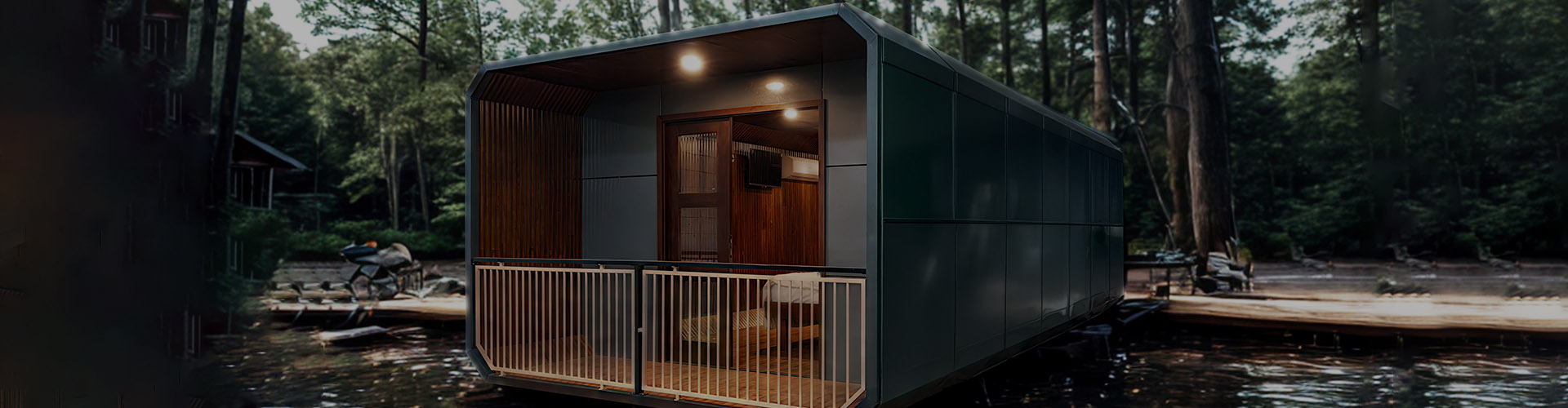
Once wood has been through that process, its performance shows up everywhere in a cottage, not in one room but as the quiet baseline underneath the whole structure. It's in flooring that stays flush instead of gapping through the seasons. It's in decking tiles that take on monsoon rain and direct sun without splintering. It's in pergola beams carrying real structural load outdoors, in wall panels and furniture that stay stable indoors regardless of air conditioning, and yes, in bathware that holds up under sustained heat and steam without swelling or staining.
That's really the point worth taking away: fortified Indonesian hardwood isn't chosen room by room. It's treated once, to a standard high enough that flooring, framing, panelling, and furniture are all just different jobs for the same dependable material. A wooden prefab cottage built this way isn't leaning on the reputation of teak as a species; it's built on wood that's actually been verified to earn that reputation.
The clearest way to understand the gap between labelled teak and properly fortified teak is to see it, not just read about it. At our Experience Centre in Devanahalli, Bengaluru, you can walk through fully built wooden cottages and see exactly how this hardwood performs across every part of the structure.