
Why Indonesian Teak Furniture Leads the Global Market
Home/ Why Indonesian Teak Furniture Leads the Global Market
Home/ Why Indonesian Teak Furniture Leads the Global Market
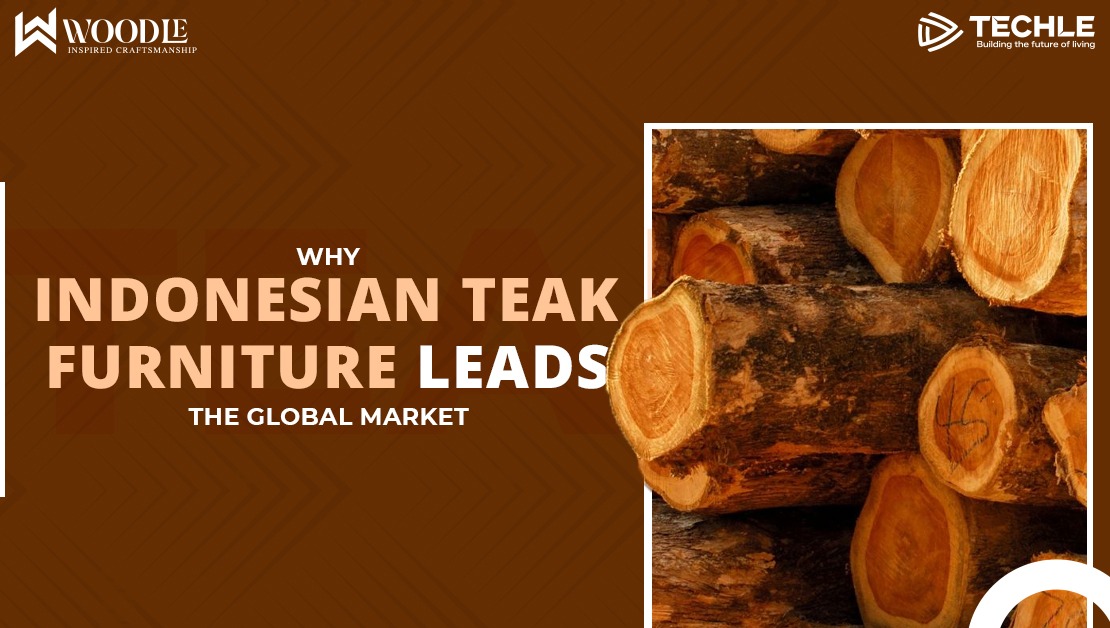
Jepara doesn't wake up to alarms. It wakes up to the scrape of hand planes on teak, hours before any machine turns on.
This coastal town in Central Java has sounded like this for generations. Long before anyone slapped "export-ready" on a label, Jepara's carpenters were already turning raw teak into furniture built to last, and it's not just skill; it's the wood itself. Java's teak is so packed with natural oil that a chair made two hundred years ago could, honestly, still hold you up today.
But here's the thing: most people never hear this part. They just see the finished product, a dining table, a tea-poy, or a bench sitting in a showroom or a catalogue – with no idea of the decades of forestry, felling, seasoning, and hard work behind it. Want to know why Indonesian teak furniture rules the world market? You've got to start at the forest and follow the wood all the way home.
Teak isn't just another hardwood. It's one of the few timber species on Earth with sufficient natural oil content to resist water, insects, and decay without any external treatment. That oil is what allowed old Javanese boatbuilders to use teak for hulls that sat in seawater for decades. It's the same property that makes teak furniture survive monsoons on an open balcony or years of daily use in a busy dining room without cracking or rotting the way softer woods do.
But teak isn't the only reason Indonesia holds this position. The archipelago's tropical climate has, over centuries, produced a whole family of dense, structurally reliable hardwoods, mahogany, merbau, meranti, and bangkirai among them, each with its character and its job to do. Mahogany brings a deep reddish-brown grain and a stability that makes it the standard for refined, furniture-grade facades. Merbau, sometimes called "ironwood", is harder and more weather-tolerant, which is why it earns its keep in outdoor structures and heavy-use pieces. This isn't a single-species story; it's a palette, and that's part of what gives Indonesian furniture its range.
Here's where a lot of the market gets it wrong. People assume Indonesian furniture is good simply because the wood is good. In reality, raw teak or mahogany straight off a truck is unstable; it's carrying moisture, it's vulnerable to insects, and if you build furniture with it directly, it will eventually crack, warp, or host termites regardless of how dense the species is. The wood needs to be engineered before it becomes furniture.
At Techle Indo Innovation, every plank that goes into a Woodle furniture piece passes through a five-stage fortification process at our facility in Jepara before it's ever cut into a table leg or a chair frame:
Sourcing: timber is procured under SVLK certification, meaning it's traceable back to a legally managed forest, not an unregulated one.
Sawing: logs are cut to precise, uniform dimensions, which matters more than it sounds like it should; inconsistent thickness is where warping problems start.
Vacuum pressure and chemical treatment: a vacuum chamber pulls moisture out of the wood while protective agents are driven deep into the fibres, reaching termites and larvae that surface treatments never touch.
Industrial kiln drying, over 10 to 15 days, which brings the final moisture content down to a stable 8–12%. This figure is the number that actually determines whether your furniture survives an air-conditioned Indian living room without cracking.
Final component processing, where the now-stabilised timber is shaped, joined, and finished into the piece it was always meant to be.
This is the part of the story that a lot of furniture brands skip past because it's less romantic than "handcrafted in Indonesia". But it's the actual reason a dining table can sit in a Bengaluru apartment through five monsoons and still not have a single hairline crack. The craftsmanship gives the wood its beauty. The fortification process gives that beauty its lifespan.
Every species has a job it does best. Here's how the three most common ones in Indonesian furniture actually compare, without pretending that any one is universally "better".
| Feature | Teak | Merbau | Mahogany |
| Character | Golden-brown, ages to silver-grey outdoors | Dark orange-brown deepens to charcoal-bronze | Deep reddish-brown, fine, even grain |
| Best suited for | Outdoor furniture, high-moisture areas, heavy daily use | Structural and outdoor pieces, decking, load-bearing furniture | Indoor furniture, formal dining sets, polished facades |
| Natural resistance | High oil content resists water and pests naturally | Naturally resistant to termites and fungal decay | Stable and warp-resistant once treated; less oil-based resistance |
| Finish | Accepts a rich, high-gloss finish or ages naturally | Rustic, heavy-duty look | High-gloss finish, considered the standard for furniture-grade facades |
None of this is a hierarchy; it's a selection guide. A resort ordering outdoor lounge furniture has a different brief than a homeowner furnishing a formal dining room, and Indonesian manufacturers who work across species (rather than defaulting everything to teak because it's the recognisable name) generally give buyers a more honest, better-fitted result.
There's a reason global buyers specifically look for Indonesian sourcing rather than treating "tropical hardwood" as interchangeable. Two things converge here that don't happen everywhere.
The first is regulation. Indonesia's SVLK system for verifying timber legality means certified furniture can be traced back to its forest of origin. This matters more than it sounds on paper; it's the difference between buying wood that's part of a managed, renewable supply chain and buying wood that may have come from illegal logging, a real and ongoing problem with teak sourced from less-regulated regions. For sourcing that supports contracts and ESG commitments, traceability isn't just an optional polish; it's often a requirement.
The second is the sourcing relationship itself. Buying through layers of middlemen adds cost and, more importantly, distance; nobody in the chain has actually seen the forest the wood came from. Techle sources its A-grade mahogany, merbau, meranti, teak, and more woods directly from Indonesian forests, with no intermediary between the source and the factory floor. That directness is what allows us to guarantee both the timber's grade and the legality of its origin, rather than relying on a supplier's word.
The range of what Indonesian craftsmanship produces is wider than most buyers expect. It isn't limited to garden chairs and dining sets; the same fortified timber and joinery techniques scale from small accent pieces to large structural furniture.
Dining tables running anywhere from 200 to 400 cm in length, meeting tables built for commercial spaces, root teapoys carved from single dense sections of mahogany or teak, sofas, lounge chairs, writing desks, vanity stools, and bedside tables, all built from the same A-grade hardwoods, pass through the same fortification process, whether the piece is destined for a private home or a hospitality project ordering in volume.
This area is also where high-density framing earns its keep. A dining table leg or a sofa frame made from properly seasoned, high-density mahogany or merbau can carry a real structural load, the kind that keeps a piece from developing the "wobble" that's common in furniture made from unstabilised or lower-grade timber.
As demand for Indonesian teak and hardwood furniture has grown, so has the market for pieces that borrow the name without the substance. A few things are worth checking before you buy, whether you're furnishing one home or sourcing for a project:
Ask for the certification. Genuine SVLK-certified suppliers can show it. If a supplier can't produce documentation tracing the wood's legal origin, that's a signal worth taking seriously.
Check the grain and density. A-Grade hardwood has a tight, consistent grain. Furniture built from lower grades or mixed species often has visible inconsistency across a single piece.
Ask about the drying process, not just the finish. A polished surface can hide unstabilised wood underneath. The moisture content at the time of manufacture, ideally 8–12%, is what determines whether the piece will hold its shape over the years, not how it looks on day one.
Indonesian teak furniture didn't earn its global reputation through marketing. It earned this reputation because the underlying materials science – dense, oil-rich hardwood, kiln-dried to dimensional stability, treated against pests at a fibre level, and shaped by craftsmen who've worked for generations – genuinely holds up better than most alternatives, indoors or out, in Indian humidity and European winters.
At Techle Indo Innovation, those are the same processes and the same species – mahogany, merbau, teak, and meranti – that go into every Woodle furniture piece we build, whether it's a single dining table or a full furnishing order for a resort. If you'd like to see and feel the difference between fortified hardwood and standard furniture-grade wood in person, our Experience Centre in Devanahalli, Bengaluru, has finished pieces you can inspect directly, alongside the Woodle and Techle home units they're designed to furnish.