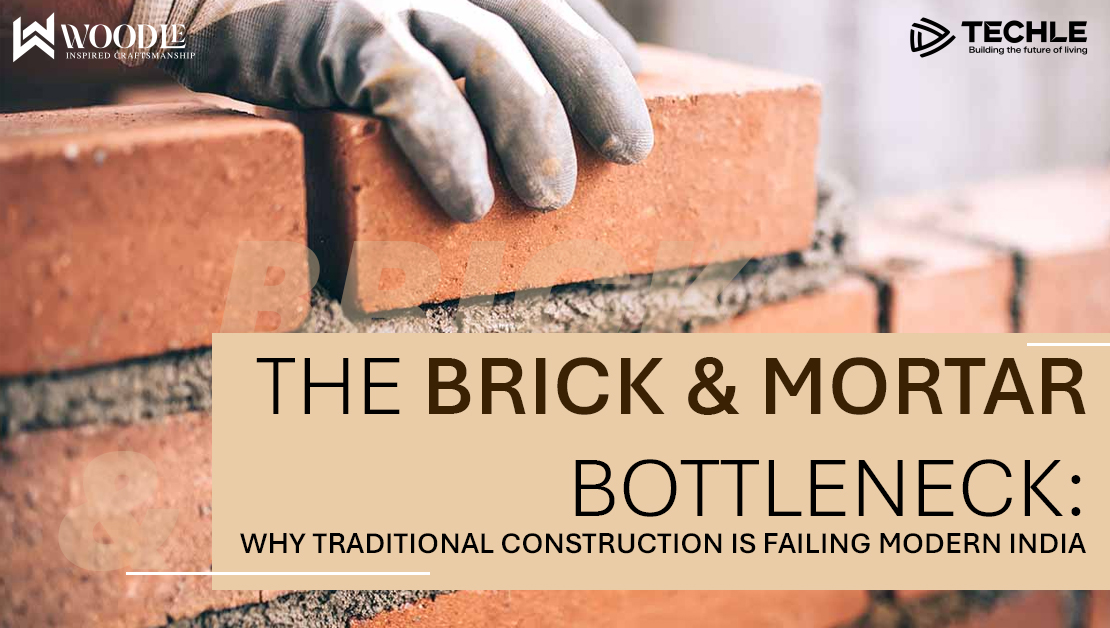
Today, the Indian construction industry is undergoing rapid change. The changes are occurring because people are moving more into sustainability and efficiency. It is a well-known fact that the traditional construction process takes months and years to get the project done. It consumes a huge amount of resources like water, electricity, labour, and time.
The modular and prefabricated construction market is projected to surge from USD 180.3 billion in 2026 to USD 307.2 billion by 2035, according to Global Market Insights. The prefab market is going to be in great demand in the future.
This is because the old traditional method is not able to cope with urbanisation and maintain sustainability. Therefore, modern construction is moving from brick-and-mortar to prefab construction.
In this blog, we’ll discuss in-depth why traditional construction is failing in modern India.
The Brick & Mortar Bottleneck Explained
Brick-and-mortar construction relies heavily on manual labor and on-site execution, making the entire process slow and rigid. Progress depends on worker availability, which directly affects timelines and costs.
It is also highly weather-dependent. Rain, heat, or humidity can pause construction for days, leading to delays and budget overruns.
Another major issue is the fragmented supply chain. Delays in material sourcing, inconsistent quality, and poor coordination reduce quality control and disrupt project flow.
Lastly, traditional concrete structures lack flexibility. Any design change requires breaking existing work, causing material wastage, higher costs, and environmental impact due to excessive water use and pollution.
In short, the brick-and-mortar bottleneck is about slow execution, low flexibility, high dependency, and unsustainable practices – challenges that modern construction can no longer afford.
Traditional Construction Is Slowly Losing the Battle
The hidden cost of traditional construction often shows up much later than expected. What looks affordable at the start becomes expensive due to delays, rework, material wastage, and extended timelines. Small issues pile up and quietly inflate the final budget. Most project overruns don’t come from design, but from inefficiency.
Labour challenges are another major roadblock. Construction work depends heavily on manpower, and unexpected leave due to health issues, family emergencies, or migration is common. When workers don’t show up, work slows down or stops completely. This uncertainty makes planning almost impossible.
Quality, consistency, and safety are difficult to maintain in traditional construction. Different workers bring different skill levels, which leads to uneven quality. Safety practices often depend on supervision rather than systems, increasing on-site risks. Over time, these gaps reduce trust and create long-term maintenance problems.
Sustainability is where traditional construction falls behind the most. It consumes large amounts of water, generates material waste, and pollutes throughout the project. With growing environmental concerns, this method no longer fits India’s push toward responsible and future-ready development.
Why Traditional Construction Can’t Scale for the Future
As India plans for rapid urban growth, traditional construction methods are proving too slow, too unpredictable, and too inefficient to support the scale of future demands.
- Smart cities need speed and precision. Traditional construction moves slowly and depends too much on manual work. Delays, errors, and rework make it hard to deliver fast and accurate outcomes. That’s a problem when cities are growing rapidly.
- Industrial growth needs predictable timelines. Factories and commercial projects run on strict schedules. Traditional methods can’t guarantee delivery dates because labour, weather, and material supply often disrupt plans. This uncertainty affects business operations and investments.
- Affordable housing needs cost efficiency. Traditional construction wastes materials, time, and money. These extra costs are passed on to buyers, making homes expensive. When margins are tight, inefficiency becomes a deal-breaker.
- Infrastructure projects need repeatability. Institutional and public buildings require the same quality again and again. Traditional construction struggles to replicate results consistently. Without standardization, scaling infrastructure becomes slow and risky.
The Shift India Can’t Ignore
The water scarcity is for real, and we can not ignore it, so it’s better to be cautious and preserve nature. Techle Indo Innovation has already initiated one step towards sustainable living, and here’s how we are making a difference:
- Knock-down Technologies: We replace unpredictable manual labor with high-precision engineering, offering easy assembly of each piece of our homes and making a final strong structure out of it.
- Advanced Engineering Techniques: With the help of the new prefab homes installation process, we have cut off the construction time from months and years to two weeks. Quick doesn’t mean that our homes are fragile; we provide a lifespan warranty of more than 30+ years.
- Off-site and Prefabricated Approaches: Our homes feature “Perfect-Fit” assembly and zero-warp guarantees; our 5-stage wood treatment process gives core protection and keeps the homes safe and strong.
- Faster Build Time: Our cottages’ build time is among the fastest installation processes because it takes only two weeks to assemble them.
- Lightweight Models: Our powder-coated aluminum sheets make it easy to carry in the mountains without the help of heavy machinery. Even one can carry the aluminum home products by hand and move them to the hilltop location.
- Climate-Smart Resilience: Whether it’s rust-free aluminum or climate-ready luxury wood, our structures are built with specialized insulation to handle India’s intense tropical sun and humidity.
Conclusion: Build for tomorrow’s sustainable living!
Traditional brick-and-mortar construction has served us for centuries, but as our needs evolve, so must our methods. When a more efficient, durable, and eco-friendly alternative exists, why settle for the status quo?
As we’ve explored, choosing prefab modular living is the most effective way to embrace sustainability without compromising on quality. If you can have a home that is faster to build, easier to install, structurally superior, and environmentally conscious, the choice is clear.
Whether you are planning your next family home, a private villa, or a getaway farmhouse, prefab is the modern answer. At Techle Indo Innovation, we specialize in diverse prefab solutions tailored for various sectors – including hospitality and tourism, luxury residential projects, and institutional buildings.
Ready to revolutionize your next project? Contact our experts today to learn how our prefab installation process can bring your vision to life sustainably.
Hi, this is a comment.
To get started with moderating, editing, and deleting comments, please visit the Comments screen in the dashboard.
Commenter avatars come from Gravatar.